The Art of Knowing Art: Pierre Bourdieu and the Invisible Currency of Taste
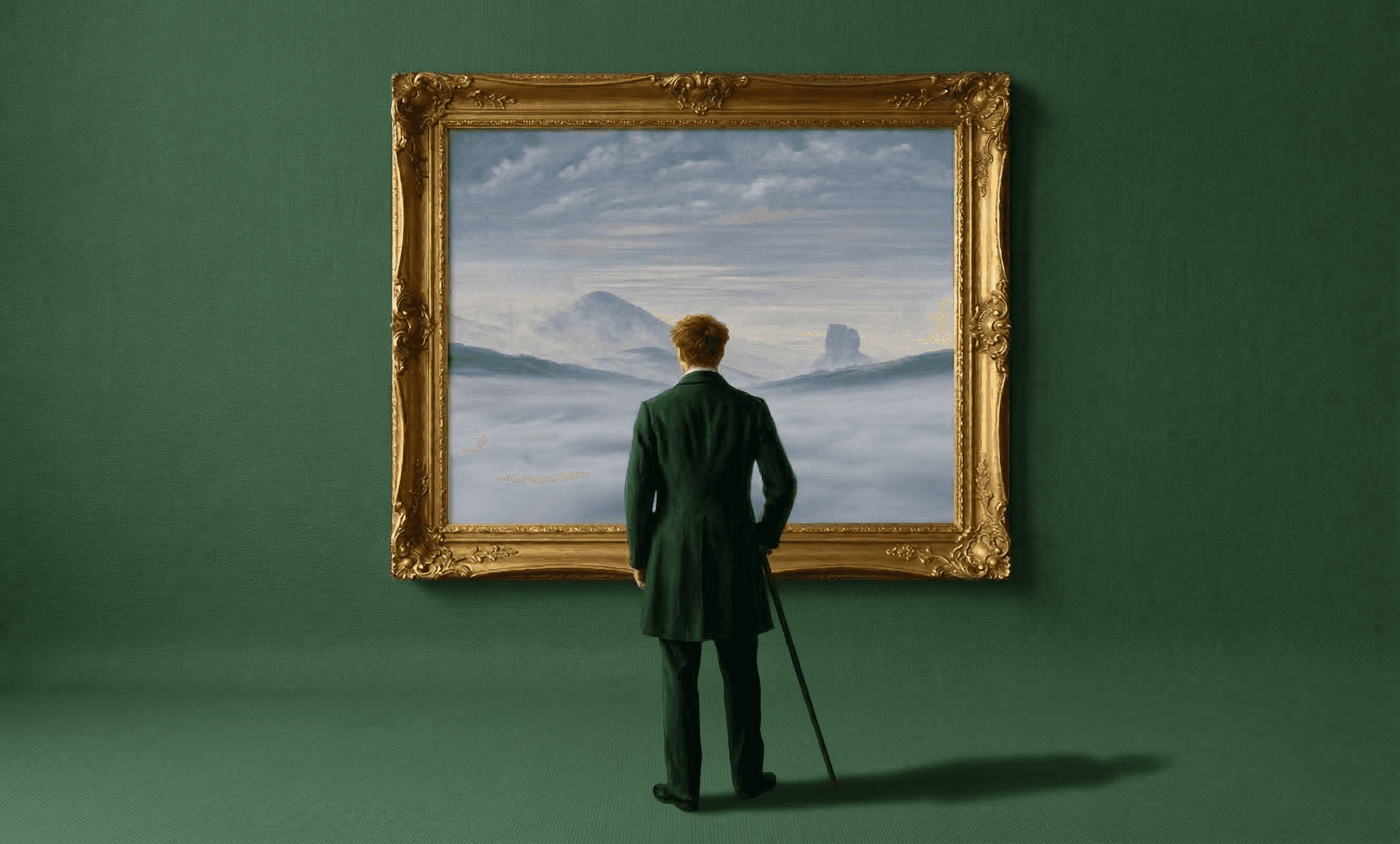
An adaption of "Wanderer above the Sea of Fog" by Caspar David Friedrich. The Wanderer views an artwork resembling the scenery in his own.
Key Takeaways
Pierre Bourdieu’s sociological framework suggests that "refined" taste in art is a form of acquired cultural capital used to maintain and reinforce existing social hierarchies. The article examines how these ingrained habits and institutional standards act as structural barriers to social mobility in both traditional galleries and modern digital spaces.
Walking into a high-end contemporary art gallery often feels less like entering a public space and more like stepping into a secular temple. The high ceilings, the "white cube" aesthetics, and the hushed, reverent whispers of the patrons create an atmosphere that demands a specific kind of conduct. To the uninitiated, the abstract splatters on a canvas or a pile of industrial felt in the corner might seem baffling, perhaps even a prank. But to the "connoisseur," these objects vibrate with historical meaning, prestige, and value.
This discrepancy—the gap between seeing and perceiving—is the foundation of Pierre Bourdieu’s theory of cultural capital. In his seminal work, Distinction: A Social Critique of the Judgement of Taste (1979), Bourdieu argues that our "refined" taste in art is not a reflection of an innate soul or superior intellect. Instead, it is a sophisticated form of currency that reinforces social hierarchies and ensures that power remains within certain classes.
The Anatomy of Cultural Capital
Bourdieu broke away from the traditional economic definition of "capital." While Marx focused on the ownership of the means of production, Bourdieu realized that in modern society, social status is maintained through more subtle, symbolic means. He identified three primary forms of cultural capital:
- Embodied State: This is the most "invisible" form. It consists of the knowledge, skills, and mannerisms we internalize over time. It is the way a person speaks, their accent, their posture, and their ability to discuss a Debussy prelude without sounding like they just read the Wikipedia entry. It cannot be transmitted instantaneously; it must be "inherited" through long-term exposure.
- Objectified State: These are physical objects that require cultural knowledge to consume. A rare first-edition book, a collection of vinyl jazz records, or a painting by an emerging neo-expressionist. While anyone can buy these if they have the money, the "cultural profit" comes from knowing why they are significant.
- Institutionalized State: This refers to formal recognition, such as degrees from elite universities or prestigious awards. These credentials provide a "certificate of cultural competence" that the labor market and high society recognize as valid.
The Habitus: Our Internalized Social Compass
Central to understanding how art affects society is Bourdieu’s concept of the habitus. The habitus is a set of deeply ingrained habits, skills, and dispositions that we possess due to our life experiences. It is the "feel for the game."

If you were raised in a household where weekends were spent in museums and dinner conversations revolved around the nuances of the Venice Biennale, your habitus is naturally "tuned" to the frequency of the art world. When you enter a gallery, you don't feel like an interloper; you feel like you are in your natural habitat.
Conversely, for someone from a working-class background, the same gallery can feel like a hostile environment. The lack of familiarity with the "codes" of high art creates a sense of exclusion. This isn't just a personal feeling; it is a structural barrier. The habitus ensures that individuals "spontaneously" gravitate toward the social positions they are already destined to occupy, making social inequality seem like a matter of personal choice or "natural" affinity.
The "Pure Gaze" vs. The "Popular Gaze"
Bourdieu’s most cutting observation regarding art is the distinction between the "pure gaze" and the "popular gaze."
The popular gaze—typically associated with the working and lower-middle classes—seeks art that is functional, representational, or emotionally resonant. It asks: Is this beautiful? Does it tell a story? Does it look like what it’s supposed to look like? The pure gaze, however, is the hallmark of the elite. It deliberately ignores the "content" or "function" of the work to focus on its form, its place in art history, and its technical execution. To the pure gaze, a painting of a gruesome scene can be "beautiful" because of its brushwork, while a "pretty" sunset might be dismissed as "kitsch" or "cliché."
This "aesthetic distance" is a luxury. To appreciate art purely for its form, one must be sufficiently removed from the urgencies of daily survival. Therefore, the ability to appreciate "difficult" or "abstract" art becomes a badge of class distance from necessity. It signals: "I have the time and the background to care about things that serve no practical purpose."
The Social Profit of Distinction
Why does this matter beyond the walls of a museum? Because the art world acts as a giant sorting machine for the rest of society. Bourdieu suggests that "culture" is the most effective way to disguise class dominance.
In a modern democracy, it is no longer polite to claim superiority because of one's bloodline or raw wealth. However, it is perfectly acceptable—even celebrated—to be "more cultured." When an employer chooses a job candidate because they "fit the culture" or because they shared an interesting conversation about a specific indie film or a gallery opening, they are often unknowingly rewarding cultural capital.
This creates a glass floor for the elite. Even if a member of the upper class loses their economic capital (money), their cultural capital (their "polish," their connections, their way of speaking) often allows them to maintain their status and eventually regain their wealth. Meanwhile, the working class faces a glass ceiling. No matter how hard they work, if they lack the "right" cultural markers, they are often excluded from the highest circles of power and influence.
The Myth of the Natural Gift
Herein lies the quiet tragedy of Bourdieu’s findings, and where a more critical, and newance perspective becomes necessary. The "art of knowing art" is presented to the world as a natural gift. We speak of "talent," "sensitivity," and "vision" as if they are divine sparks distributed randomly across the population.
Bourdieu argues that this is a convenient myth. By framing aesthetic taste as an innate quality, society masks the fact that it is actually a product of unequal educational and familial resources. If we believe that the elite are in power because they are "more refined" or "smarter" (as evidenced by their "good taste"), then the social hierarchy seems justified.
"The sacralization of culture and art fulfills a vital function by contributing to the conservation of the social order." — Pierre Bourdieu
In this light, museums and educational institutions are not just neutral dispensers of knowledge. They are "consecrating" institutions. They take the cultural preferences of the dominant class and label them as "Universal Culture," while dismissing the preferences of the working class as "low-brow" or "vulgar." This is a form of symbolic violence—the process by which dominated groups come to accept the legitimacy of their own subordination because they believe they simply lack the "natural" ability to understand "high" culture.
The Digital Age: Democratization or New Barriers?
In 2026, one might argue that the internet has leveled the playing field. We have Instagram, TikTok, and digital archives that make art accessible to everyone. Surely, the "old guard" of cultural capital is crumbling?
While the access to art has increased, the mechanisms of distinction have simply become more complex. In the digital age, cultural capital is often found in "algorithmic literacy"—knowing how to navigate the right subcultures, using the right "aesthetic" (like Dark Academia or Cottagecore), and possessing the "niche" knowledge that separates one from the "mainstream" masses.
Even in digital spaces, the "pure gaze" persists. The "ironic" appreciation of "bad" art or the celebration of "hyper-niche" internet genres requires a significant amount of prior cultural knowledge to decode. The game hasn't ended; the board has just expanded.
Conclusion: Decoding the Canvas
Pierre Bourdieu didn't want us to stop enjoying art. Rather, he wanted us to understand the social "work" that art does. When we look at a painting, we aren't just engaging in a private emotional experience; we are participating in a social ritual that reinforces our place in the world.
Understanding the "art of knowing art" is the first step toward demystifying the barriers that keep society stratified. By recognizing that taste is a learned behavior rather than an innate gift, we can begin to challenge the institutions that use "culture" as a gatekeeping tool.
The next time you find yourself in a museum, feeling either a sense of smug belonging or a pang of confused alienation, remember: the "meaning" of the art isn't just on the canvas. It’s in the invisible threads of capital that connect the viewer, the institution, and the structure of society itself.
Sources
Read Next
Orbán is gone. What happens now?
Following their historic electoral victory over Viktor Orbán, Péter Magyar and the Tisza Party aim to fundamentally transform Hungary through a comprehensive plan designed to dismantle state corruption, revitalize the welfare system, and pivot toward a knowledge-based economy. Additionally, the new government seeks to decisively realign the country with the European Union.
Closed Skies: Europe Limits US Military Logistics as Trump Threatens NATO
The ongoing US-Israeli military campaign against Iran and its regional proxies has exposed significant diplomatic strains within the NATO alliance. Over the past 72 hours, targeted decisions by several major European powers have imposed specific constraints on US and Israeli military logistics across the continent. This is not a complete breakdown of transatlantic unity, but a clear, real-time assertion of sovereign limits — driven by domestic political pressures, adherence to bilateral agreements and international law, force-protection concerns for their own troops, and differing strategic priorities.

The European Parliament’s New Landmark Vote on Migration, Explained
In a significant shift, the European Parliament adopted a strict negotiating mandate to overhaul the EU's deportation rules, driven by an alliance between center-right and far-right factions. The Return Regulation aims to accelerate removals through measures including the legal foundation for offshore "return hubs" in third countries, expanded detention powers, the elimination of automatic appeal suspensions, and stronger penalties for non-compliant asylum seekers. A final deal is anticipated by June 2026.