Paving the NS Path: Elite Culpability vs. Societal Complicity in the Fall of Weimar

Who unlocked the pandora's box of fascism in Germany?
Key Takeaways
Conservative elites bear primary responsibility for deliberately dismantling Weimar's democratic institutions and handing power to Hitler through tactical miscalculations and shared ideological interests, yet broad societal complicity—fueled by widespread antisemitism, envy, political violence, and fragmented opposition across classes and parties—enabled the Nazi mass movement to thrive in a democratic context that lacked a culture of compromise. To prevent similar authoritarian takeovers, societies must actively defend democratic norms against elite sabotage, foster cross-ideological unity against extremism, and address underlying social resentments before they become exploitable by radical movements.
The crimes of National Socialism, particularly the industrially organized mass murder and the unleashing of the Second World War, mark a rupture in civilization that continues to shape international politics to this day. While the significance of external factors—such as the political instrumentalization of the Treaty of Versailles—is historically largely undisputed and later significantly influenced the motivation for European integration, there is less consensus regarding the domestic causes of the Nazi rise to power.
Central to this is the question of responsibility: Was the Weimar Republic primarily condemned to failure by the incompetence of its conservative elites, or was National Socialism carried by a broad societal base? To illuminate these differing explanatory approaches, the positions of two historians are contrasted below. The French historian Johann Chapoutot focuses on the culpability of the conservative upper class, while the German historian Götz Aly advocates the thesis of a "dictatorship of favors" (Gefälligkeitsdiktatur) based on broad popular approval. This selection serves as an exemplary illustration of the controversial scholarly opinions regarding who paved the way for Hitler.
Part 1: Johann Chapoutot
In his book Les Irresponsables (The Irresponsible), Johann Chapoutot dedicates his attention to those circles that initially underestimated the potential of the NSDAP (Nazi Party) and, through their actions, ultimately paved Hitler’s path to power. For Chapoutot, these "irresponsibles" are primarily the conservative elites who, due to their close entanglement with the monarchist-military milieus, were hostile to the Weimar Republic from its very inception. Following the defeat in the First World War and the proclamation of the Republic, they propagated the subsequent "stab-in-the-back" myth (Dolchstoßlegende), according to which the Imperial Army had remained undefeated in the field but was "stabbed in the back" by leftists and Jews at home. This constructed narrative served as an ideological breeding ground for the rejection of the young democracy by many Germans and simultaneously laid the foundation for the antisemitism propagated by the NSDAP.
Chapoutot specifically analyzes the top-down effects of this monarchist-military elite. This group decisively dominated the administration, as well as cultural and political institutions, acting as a dominant opinion-maker to fuel revanchism and antisemitism. This dominance was reinforced by the election of Paul von Hindenburg as Reich President in 1925—a moment historians describe as the "conservative refounding" of the Weimar Republic. According to Chapoutot, parliamentary democracy effectively ended in 1930 with the appointment of Heinrich Brüning as Reich Chancellor.
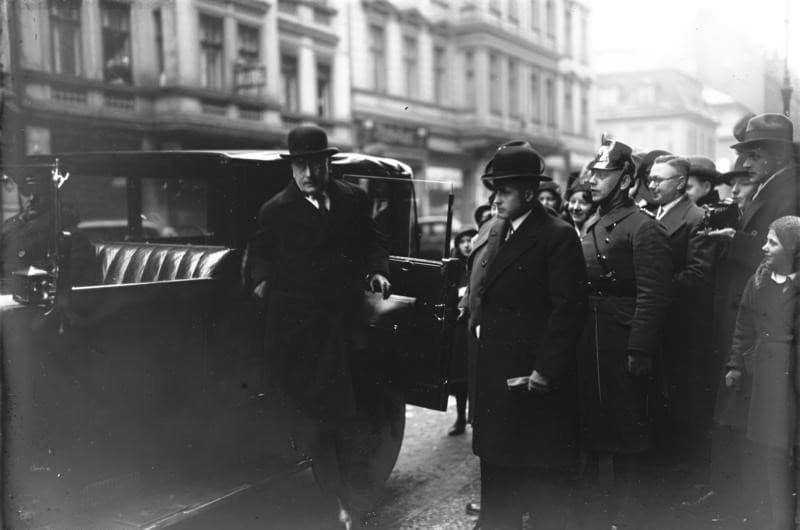
The presidential cabinet instrumentalized Article 48 of the Weimar Constitution to centralize power, yet this did not lead to political stability. Instead, support grew for parties seeking to abolish the Republic—primarily the KPD (Communist Party) and the NSDAP—alongside a rise in political violence. The Great Depression exacerbated this instability, particularly because the conservatives, despite their extensive power from 1930 onwards, failed to find political solutions. Alongside the "voluntary labor service" (Freiwilliger Arbeitsdienst), which aggravated the plight of the precariat through cuts in social benefits and the introduction of forced labor, a strict policy of deflation and austerity was enforced. This led to an intensification of the recession, rising unemployment, and a massive decline in purchasing power.
The conservative elites thus paved the way for the NSDAP—firstly through their inability to use their power to solve the economic crisis, and secondly through their constant fueling of revanchism and antisemitism. The sustained delegitimization of the Republic led to a weakening of the democratic center. Against this backdrop, conservatives increasingly felt compelled to choose between the communist Left and the rising NSDAP to secure their own power. Pronounced anti-communism, as well as substantive overlaps with the NSDAP—especially regarding the strengthening of the military, the rejection of the Treaty of Versailles, and the protection of industrial property rights—finally led to the transfer of power. Although Reich Chancellor Franz von Papen still clung to the delusion in 1932 that he could politically tame Hitler, and figures like Kurt von Schleicher tried in vain to split the NSDAP by integrating its "left" wing under Gregor Strasser, the tactical maneuvering of the elites culminated in Hitler’s appointment as Reich Chancellor on January 30, 1933.
Part 2: Götz Aly
For Götz Aly, National Socialism grew as a mass movement—a movement that extended across all social strata. Cultural, social, and economic conditions ensured that a broad mass of people was receptive to this movement.
In an interview, he repeatedly emphasizes: "No Hitler without democracy!"
For centuries, authoritarian structures prevailed in Germany. The "culture of compromise," for which Germany is known in the EU today, was unthinkable at that time. In the "experiment" of the Weimar Republic, political camps viewed one another as enemies rather than adversaries. It was not only the conservatives and the NSDAP who contributed to this hostile climate, but also the communists and, to a certain extent, the parties of the center, including the Social Democrats. With the emergence of parliamentary democracy, the parties became aware of their potential new power, having had only limited influence during the Imperial era. This prompted the parties to distance themselves from one another all the more strongly. The brutalization of political language went hand in hand with a habituation to physical violence. This was apparent from the beginning: it started with the Spartacist Uprising in 1919 and the battles between paramilitary Freikorps and communists. In the 1920s, political assassinations (such as those of Matthias Erzberger or Walther Rathenau) were not uncommon. Violence escalated particularly in street battles between the SA (Stormtroopers) and the Red Front Fighters' League (Rotfrontkämpferbund), which intensified further after the global economic crisis of 1929. Aly views this habituation to violence not merely as an explanation for the later cruelty of the concentration camp system. The ubiquity of political violence meant that society was less shocked by the openly violent Nazi platform during election campaigns. Many people increasingly elevated the NSDAP to a force of order that promised simple answers to the chaos.
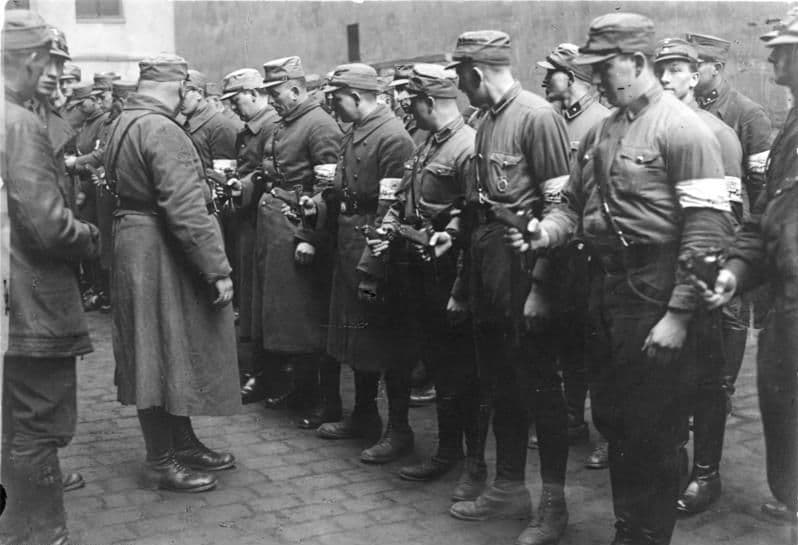
While the tactical errors of the conservative elites played into the hands of National Socialism, Aly argues that the conservatives would never have been forced into the predicament of choosing between communists and National Socialists had the NSDAP faced unified resistance from progressive forces earlier on. However, the KPD and SPD (Social Democratic Party) cultivated their enmity instead of uniting in the face of immediate danger. The KPD aimed for the overthrow of democracy from the start and contributed to the poisoning of the debate culture through a high degree of verbal aggression. Social Democrats were defamed as "social fascists"—the "social fascism speech" by Ernst Thälmann being particularly defining in this regard. Aly includes the trade unions in this collective responsibility, noting their refusal to engage in joint protest actions with actors from the KPD and the Center Party (Zentrum). Consequently, resistance against the National Socialists remained fragmented throughout the Weimar period.
A primary argument for Aly regarding the character of a mass movement is the social envy toward Jewish fellow citizens prevalent at the time. This was propagated not only by conservatives and, in a radicalized form, by National Socialists, but was also supported in an ambivalent manner by communists. By propagating the "working class versus bourgeoisie" conflict, the KPD indirectly fostered antisemitic stereotypes, as Judaism was often broadly associated with capital. In his books, Aly describes in detail that the Jewish population tended to possess greater wealth and education. As an example, he cites the density of telephone connections in Stuttgart: while Jewish citizens made up only 1.5% of the population around 1900, 20% of telephone connections were registered to them. Strong intellectual encouragement in Jewish families explained their overrepresentation in academic professions. Aly particularly highlights antisemitism among those who were the first in their families to attend university at that time and viewed Jewish peers as competitors. Remarkably, almost all participants in the Wannsee Conference held academic degrees—the sole exception being Reinhard Heydrich, who, as a former officer, held no degree. Revanchism, as well as greed and social envy, permeated the entire German society—whether educated or uneducated, rich or poor, old or young.
Sources
Read Next
Orbán is gone. What happens now?
Following their historic electoral victory over Viktor Orbán, Péter Magyar and the Tisza Party aim to fundamentally transform Hungary through a comprehensive plan designed to dismantle state corruption, revitalize the welfare system, and pivot toward a knowledge-based economy. Additionally, the new government seeks to decisively realign the country with the European Union.
For the German Social Democracts, 2026 Is About Survival. Why Is That?
The SPD's disastrous results in yesterday's state election were a personal and communication failure.

Human-Scale Design: European Cities’ Biggest Bottleneck Is Right in Front of Your Eyes
European cities are actively dismantling the car-centric urban planning of the 20th century by embracing an "intermodal trinity" of walking, cycling, and public transit. This shift not only measurably improves public health, but it also democratizes mobility by ensuring equitable access for all citizens. By leveraging their historic, human-scaled infrastructure, these cities are pioneering a future where proximity and community replace congestion and pollution.